Sustainable WASTEWater Treatment with HIGH PERFORMANCE Boron-Doped Diamond Electrodes

BDD EAOPs Wastewater Treatment Module NF-CT11/NF-CT9/NF-CT7
Short Description:
At New Frontier Tech, we have achieved industrial-scale manufacturing of BDD electrodes and developed the NF-CT11/NF-CT9/NF-CT7 series electrochemical modules, incorporating BDD anodes paired with titanium cathodes. These modules serve as core components in industrial wastewater electrolysis cells, enabling effective degradation of organic pollutants through electrocatalytic oxidation technology. The system design allows a series connection of multiple modules to optimize overall treatment performance in wastewater processing applications.
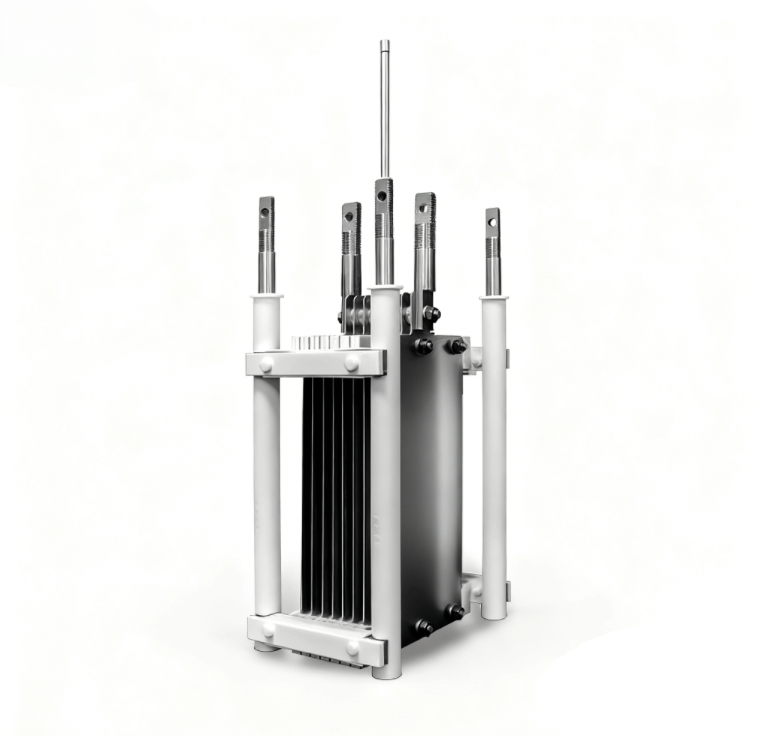
Application areas: in the detail section
Main features:
◎ Professional module design, easy to install
◎ Compact electrochemical module, saving space
◎ Expandable design, can be connected in series
Technical Parameters:
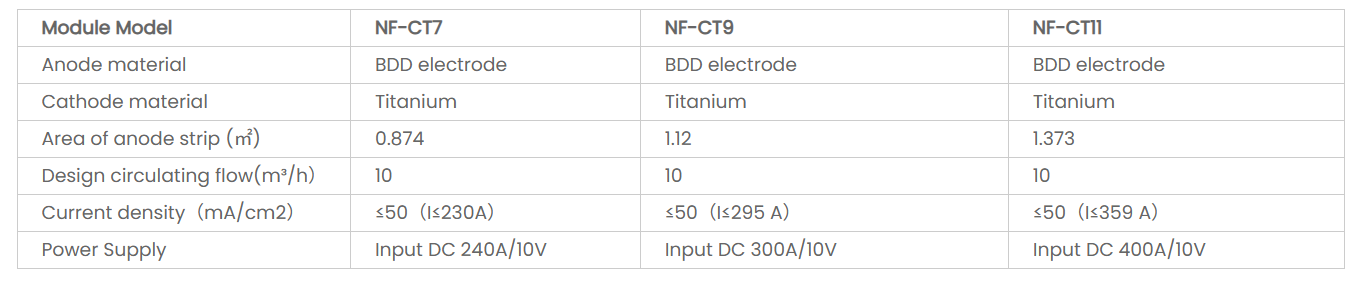
Application areas:
NF-CT11/NF-CT9/NF-CT7 series module adopted diamond-coated plate BDD electrodes, particularly suitable when industrial wastewater with high salt, high COD, high toxicity, strong acid, and strong alkali requires electrochemical oxidation treatment for difficult-to-biodegrade organic industrial wastewater. New Frotier Tech has successfully adopted this in coking wastewater, petrochemical wastewater, pharmaceutical wastewater, pesticide wastewater, heavy metal wastewater, catalyst wastewater, high-concentration extraction waste liquid (containing extractants and oil) generated during the recycling process of waste lithium batteries, etc., wastewater treatment solution.
For example, during the coal chemical coking wastewater treatment project, New Frontier Tech combines BDD EAOPs (electrochemical advanced oxidation processes) technology to provide a reliable integrated treatment solution to treat the membrane concentrate from biologically treated effluent and MVR evaporation mother liquor. This solution effectively controls key parameters, including CODcr, TOC, ammonia nitrogen, and pH, achieving the customer's goal of wastewater reuse for slag cooling. The treatment capacity reaches 12 m³/h, with COD reduced from 1200 mg/L to 150 mg/L and ammonia nitrogen decreased from 600 mg/L to 25 mg/L.
The environmental persistence and toxicological impacts of organic pollutants in wastewater represent one of the century's most pressing ecological concerns. Contemporary wastewater treatment systems employ BDD electrochemical advanced oxidation technologies (alternatively termed electro-oxidation processes) for practical applications across multiple sectors. These include pre-treatment, post-treatment, and integrated treatment schemes for industrial effluents generated from textile coloration, petrochemical operations, pulp/paper production, and leather manufacturing.
In electrochemical oxidation processes, redox reactions occur simultaneously at the electrode interface and within the solution bulk, where the anode material critically determines the efficiency and selectivity of organic compounds. Boron-doped diamond (BDD) electrodes exhibit superior characteristics, including exceptionally high oxygen evolution potential, the widest electrochemical stability window, and remarkable corrosion resistance in strongly acidic/alkaline environments. Compared to conventional metallic electrodes (PbO₂, SnO₂, IrO₂) and mixed metal oxide (MMO) electrodes, BDD electrodes demonstrate superior performance as advanced anode materials for the electrochemical treatment of refractory organic wastewater.
New Frontier Tech has achieved industrial-scale manufacturing of BDD electrodes and developed the NF-CT11/NF-CT9/NF-CT7 series electrochemical modules, incorporating BDD anodes paired with titanium cathodes. These modules serve as core components in industrial wastewater electrolysis cells, enabling effective degradation of organic pollutants through electrocatalytic oxidation technology. The system design allows a series connection of multiple modules to optimize overall treatment performance in wastewater processing applications.
Contact
Reach out with questions or project ideas
© 2025. All rights reserved.
Call/Wechat/Whatsapp:
+86 186 70330664
Email: info@bddwater.com